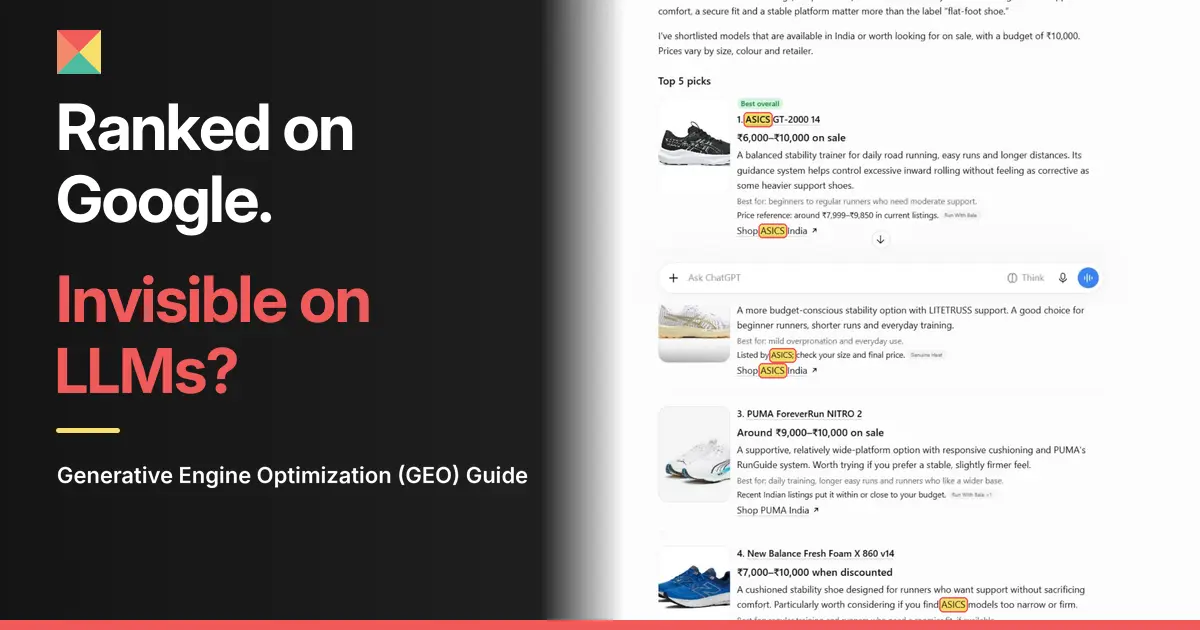
Generative Engine Optimization (GEO) is the practice of improving the likelihood that your brand’s content, products, or expertise are discovered, used, and cited when an AI/LLM system generates an answer according to the user-defined query.
This mainly includes optimized content structuring (clear, specific answers AI systems can extract and quote), brand citation building (earning mentions in reviews, guides, and communities AI platforms draw on), technical accessibility for AI crawlers, accurate and consistent brand and product information.
Imagine someone asks an AI assistant: “running shoes best for flat feet with a budget of ₹2,000 to ₹10,000?”
The assistant might reply with five or six shoes, a line on why each suits flat feet, and links to a few sources. Those sources could be brand product pages, expert buying guides, retailer listings, review articles/blogs from an athlete or runner forums.
The user may never see a traditional results page. The rendered list is the search result.
This also raises a point that it isn’t only about ranking a page. It’s about how your brand is represented inside answers from tools like ChatGPT, Google AI Overviews and AI Mode, Gemini, Perplexity, and Copilot. Are you mentioned? Are you described accurately? Is your page the one that gets linked?
AI Impact on Search
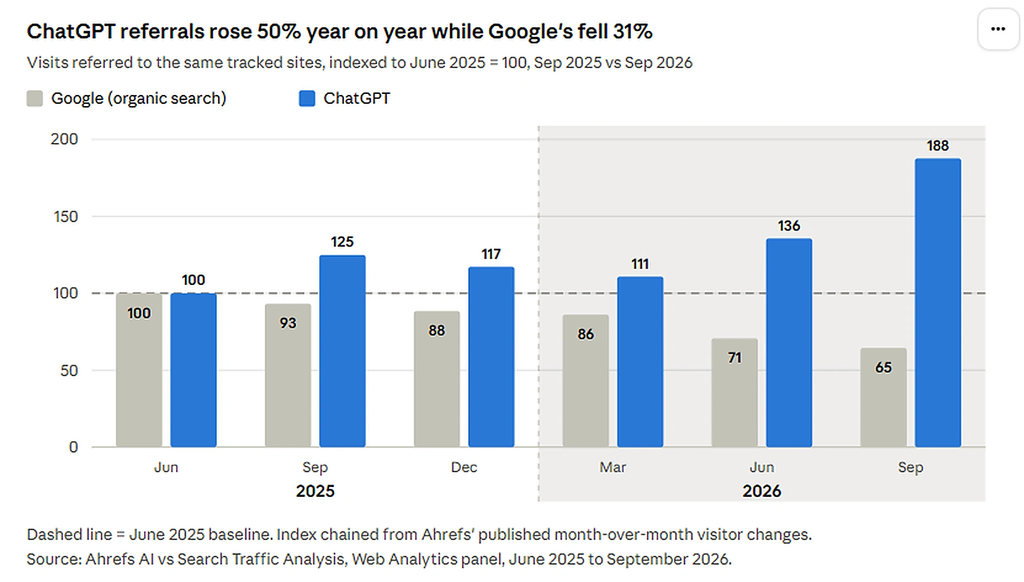
The clearest year-on-year evidence comes from Ahrefs’ AI vs Search Traffic Analysis, which tracks the same 100,000+ websites month after month.
Between September 2025 and September 2026, visits referred by ChatGPT grew by about 50%, while visits referred by Google fell by almost a 31%:
How does Generative Engine Optimization (GEO) work?
Now, here’s where things get interesting. A search-enabled AI system doesn’t simply look up your exact words. It interprets the question, often runs several related searches, and builds an answer from what it finds.
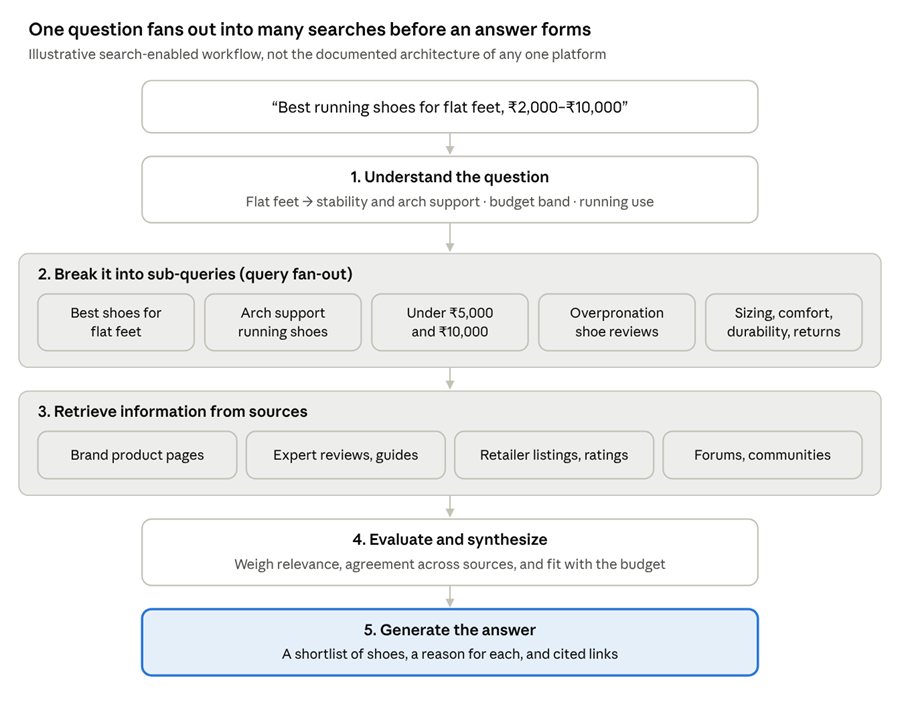
Alt text: Illustrative query deconstruction for the running-shoes example
No two AI platforms work the same way, and most don’t publish their internals. But the general workflow looks like this:
- Understanding the question: The system works out intent, context, and constraints. “Flat feet” implies stability or arch support; “₹2,000 to ₹10,000” is a hard filter.
- Breaking down the information need: The most realistic approach, in our team’s finding, is a query fan-out approach, where the system breaks one question into several related sub-queries, searches each one in parallel, and combines the results into a single answer.
- Retrieving relevant information: Search-enabled systems pull from web pages, product feeds, and other sources they can access. ChatGPT search, for example, relies on OpenAI’s OAI-SearchBot crawler; sites that block it won’t be shown in ChatGPT search answers.
- Evaluating and synthesizing: The model weighs what it retrieved alongside its own training. How each platform selects and ranks sources varies and is largely undisclosed.
- Generating the answer: The output may include product picks, explanations, brand mentions, and citations or links.
- The GEO opportunity: Each sub-query is a chance to be retrieved. A page that answers one of them clearly, accurately, and verifiably has a reason to be pulled in.
Note: not every LLM searches the web. A model answering without browsing relies only on what it learned in training, so fresh pages can’t influence it until it’s retrained. Search-enabled assistants, AI search engines, and Google’s AI features are where GEO has the most direct leverage.
What does excellent GEO look like in real search?
Let’s return to the runner with flat feet with a budget of ₹2,000–₹10,000 looking for a running shoe. This time we’ll look at real data, and be careful about what it can and can’t prove.
The search We ran, and what it shows
Platform: ChatGPT · Date: 29 October 2026 · Location: India · Exact prompt: “best running shoes for flat feet India under 10,000 in 2026”
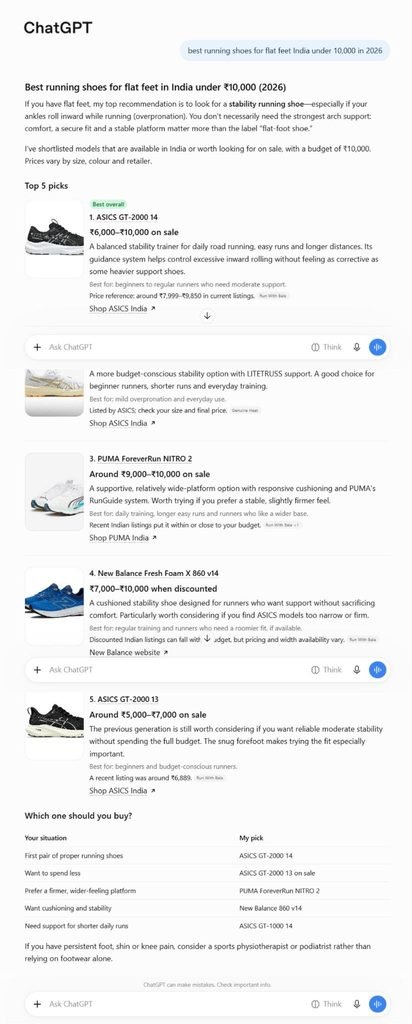
| S.No | Product | Price ChatGPT gave | Why it said so | Linked to / cited |
| 1 | ASICS GT-2000 14 (“Best overall”) | ₹6,000–₹10,000 on sale; about ₹7,999–₹9,850 in current listings | Balanced stability trainer; guidance system controls inward rolling | Shop ASICS India · Run With Bala |
| 2 | ASICS model, name hidden in capture (likely GT-1000 14, which appears in its buying table) | Listed by ASICS; “check your size and final price” | Budget stability with LITETRUSS support, mild overpronation | Shop ASICS India · Genuine Heat |
| 3 | PUMA ForeverRun NITRO 2 | About ₹9,000–₹10,000 on sale | Wide, supportive platform with PUMA’s RunGuide system | Shop PUMA India · Run With Bala +1 |
| 4 | New Balance Fresh Foam X 860 v14 | ₹7,000–₹10,000 when discounted | Cushioned stability; roomier option if ASICS feels narrow | New Balance website · Run With Bala |
| 5 | ASICS GT-2000 13 | About ₹5,000–₹7,000 on sale; a recent listing about ₹6,889 | Previous generation, reliable moderate stability, snug forefoot | Shop ASICS India · Run With Bala |
Why might these brands have been recommended?
ChatGPT doesn’t explain how it picks sources, so these are evidence-based hypotheses from our experience.
SEO and content quality
- ChatGPT repeated named technologies: ASICS’s guidance system and LITETRUSS, PUMA’s RunGuide. Specific claims like these are easy for an AI to carry into an answer.
- All three linked brands have crawlable official India product pages with model, support type, and price.
Brand visibility and authority
- An independent running reviewer was cited on four of five picks. In-depth reviews from trusted niche publishers may matter more than a brand’s own site.
- ASICS also appeared in every India-specific flat-feet guide in a separate web search the same day.
Public reviews and product reputation
- The GT-2000 13 has 1,658 ratings averaging 4.2 on Flipkart, with buyers linking it to overpronation.
- Decathlon’s Kiprun KS900 has 713 reviews but didn’t appear, possibly because it gets fewer independent reviews. (Untested.)
Here’s a subtle trap worth noticing. Every price ChatGPT gave was a sale price. The GT-2000 13’s list price on Flipkart is ₹12,999, well above the budget; it only fits when discounted. If your prices, stock, and product feeds aren’t current, an AI may recommend you at a price the shopper can’t find, or drop you for one it can verify. Keeping that information fresh is a quiet but real GEO lever.
GEO vs Traditional SEO: what’s actually different?
GEO and SEO aren’t rival disciplines. They share most of their foundations. What differs is where discovery happens and how you measure success.
| Comparison factor | Traditional SEO | GEO |
| Primary discovery experience | Search results pages with ranked links | AI-generated answers and generative search experiences |
| Core objective | Improve search visibility and relevant organic visits | Improve the likelihood of brand discovery, mentions, citations, and recommendations in AI answers |
| User experience | User scans listings and visits websites | User may get a synthesized answer, often without clicking |
| Content approach | Search intent, relevance, quality, useful landing pages | Clear, specific, verifiable information that answers sub-questions and is easy to synthesize |
| Keyword strategy | Keywords, search intent, topic coverage | Conversational questions, context, entities, and the related needs a question fans out into |
| Technical foundations | Crawlability, indexability, site architecture, performance | Largely the same; Google says AI features need no extra technical requirements, but other platforms use their own crawlers (e.g. OAI-SearchBot) |
| Authority and trust | Relevant links, reputation, expertise, quality signals | Credible information and consistent brand presence across sources AI systems can retrieve |
| Visibility measurement | Rankings, impressions, CTR, organic traffic | AI mentions, citations, share of voice, answer inclusion, AI referral traffic |
| Conversion measurement | Leads, sales, assisted conversions | Leads and sales from AI referrals where measurable, plus assisted-conversion analysis |
| Reporting challenges | Measurable but imperfect | Answers vary by prompt, platform, location, account, and time; few first-party reports exist |
Notice what’s not in the table: a ranking formula for GEO. There isn’t a published one, and each AI platform selects sources differently.
Why shouldn’t you abandon traditional SEO?
From our Own research, we can say that search engines still sent roughly 60 times more visits than AI assistants in that panel.
And for Google’s own AI features, the entry ticket is traditional SEO. Google’s documentation says a page must be indexed and eligible to show with a snippet to appear as a supporting link in AI Overviews or AI Mode, with no additional technical requirements. Neglect SEO and you weaken both channels at once.
Where Traditional SEO still does the heavy lifting?
We as a marketing agency hear this from our clients a lot: “Should we stop doing SEO and start doing GEO?”. from our perspective, It’s the wrong question. Most GEO wins we’ve seen, sit on top of solid SEO. If an AI system can’t crawl, index, or understand your page, nothing else you do on it matters.
Technical SEO: crawlability and indexability
Technical SEO makes sure search engines and AI crawlers can reach, read, and index your pages.
- Allow the right crawlers: check robots.txt; blocking OAI-SearchBot keeps you out of ChatGPT search.
- Make content readable: fast mobile pages, clean urls with key facts in plain HTML text, not hidden in images or scripts.
None of this guarantees an AI mention, but it makes you eligible.
On-page SEO: titles, headings, and meta descriptions
On-page SEO tells crawlers and real visitors what a page is about at a glance.
- Write descriptive titles and meta descriptions: “Stability Running Shoe for Overpronation” beats “Shop Now”, and a useful meta description tells searchers why to click.
- Structure with headings: one clear H1, then H2s and H3s that mirror real questions.
These aren’t proven GEO ranking factors, but clarity helps every system understand you.
Internal linking strategy
Internal links connect related pages so crawlers and users can follow a logical path.
Link category → sub-category → product pages, connect guides like “running shoes for flat feet” to the relevant products, and use descriptive anchor text instead of “click here”.
Good internal links show how your informational and product pages fit together.
Backlinks and brand authority
Backlinks and brand mentions signal that others trust and talk about you.
- Earn editorial coverage: reviews, buying guides, and expert roundups in your niche.
- Be present where buyers research: forums, communities, and comparison sites.
- Avoid shortcuts: paid or manipulative link schemes put your search visibility at risk.
Links don’t guarantee AI citations, but they put your brand in more places AI systems retrieve from.
Structured data | Schema Markup
Structured data (usually JSON-LD schema markup) labels a page’s key facts, such as product, price, stock, and rating, so machines don’t have to guess.
- Use the right types: Product, Offer, Review, Organization.
- Match the page: markup must show the same price and stock shoppers see.
- Keep it current: update it when prices or availability change.
It doesn’t guarantee rich results or AI citations, but it brings clarity to AI and other crawlers about your organisation, products and solutions.
Why does AI visibility tracking matter most?
Here’s the question we put to every client: if your website ranks well on Google but AI platforms never mention your brand, how would you know?
Most wouldn’t. Rank trackers and Search Console were built for a results page of links. Google even folds AI Overviews and AI Mode appearances into its overall Search Console traffic rather than reporting them separately. A brand can look healthy in SEO reports while being absent from the answers its buyers read.
Which Metrics should businesses track from an AI Visibility Perspective?
| Metric | What it tells you | Type |
| AI brand mentions | How often your brand appears in relevant AI answers | Visibility |
| Citation visibility | Whether AI platforms cite or link to your own pages | Visibility |
| Share of voice | Your mentions relative to competitors across a fixed prompt set | Visibility |
| Recommendation frequency | How often you’re in the shortlist, not just named in passing | Visibility |
| Prompt coverage | Which customer questions and intents trigger your brand, and which don’t | Visibility |
| Competitor visibility | Who appears for the same prompts, and with what framing | Visibility |
| AI referral traffic | Visits from identifiable AI platforms in your analytics | Traffic |
| Business outcomes | Leads, sales, and assisted conversions linked to AI-driven visits | Outcome |
How should AI visibility be measured?
Here’s a quick checklist you can follow to measure your AI visibility:
1. Build a prompt list from real customer questions. Use sales calls, support tickets, site search, and Search Console queries, not invented prompts.
2. Group prompts by intent: informational (“do flat feet need stability shoes?”), commercial (“best stability shoes under ₹10,000”), and transactional (“GT-2000 13 price”).
3. Test across the platforms your customers use, such as ChatGPT, Google AI Mode and AI Overviews, Gemini, Perplexity, and Copilot.
4. Record everything: brand mentions, position in the list, cited URLs, competitors named, and how you’re described.
5. Repeat on a schedule with the same prompts and documented conditions (logged in or out, location, date).
6. Compare with analytics and conversions, so visibility changes can be tied to traffic and revenue where possible.
7. Find the gaps and prioritise: prompts where competitors appear and you don’t, or where you’re described inaccurately.
Tools and reporting
Here’s a quick look at the tool guide you can use to track your AI visibility:
| Tool | What it measures | Platforms covered | Data type | Key limitation |
| Bing Webmaster Tools: AI Performance | Citations, cited pages, and grounding queries for your site | Microsoft Copilot, Bing AI summaries, select partners | First-party, observed | No click data; no filter by individual surface (Practical Ecommerce) |
| Google Search Console | Clicks and impressions, including AI Overviews and AI Mode | Google Search | First-party, observed | AI features aren’t broken out from overall search traffic |
| Google Analytics 4 / Adobe Analytics | Sessions and conversions from AI referrer domains (e.g. chatgpt.com, perplexity.ai) | Any AI platform that passes a referrer | Observed on your site | Misses visits where referrers are stripped; needs a custom channel group |
| Ahrefs Brand Radar | AI mentions, citations, and share of voice; custom prompts | AI Overviews, AI Mode, ChatGPT, Perplexity, Gemini, Copilot | Sampled; prompts modelled from search data | Index prompts come from search keywords and People Also Ask, not real AI conversations |
| Semrush AI Visibility Toolkit | Brand mentions, sentiment, competitor share of voice | ChatGPT, Gemini, Perplexity, Google AI Mode (coverage varies by report) | Sampled prompt runs | Platform coverage differs between reports within the toolkit |
Bottom line: AI visibility tracking shows you where you’re being discovered, where competitors are gaining ground, and where your content needs work. Without it, you’re optimising blind.
Conclusion
More and more people now find brands through AI tools. Still, GEO doesn’t replace SEO; it builds on it. It adds new questions about how your brand is described, cited, and recommended across platforms that change their answers from one run to the next.
Running this kind of research, separating real findings from coincidence, and spotting the patterns behind AI recommendations takes expertise, patience, and deep knowledge of both AEO/GEO and SEO. A single screenshot proves little. repeated testing, careful measurement, and years of research experience turn it into a strategy you can act on confidently.
How Trigital Solutions can help your business with GEO?
Choosing an AEO/GEO agency can be a hassle. Almost every agency now claims to “do GEO”, but few can show how they test what works, or how they’ll prove it’s working for you.
That’s where we’re different. Our team regularly scrapes and monitors AI answers across ChatGPT, Google AI Overviews and AI Mode, Gemini, Perplexity, and Other LLMs. We test our theories on live queries, just like the running-shoes example above, and keep only what holds up across repeated runs, dates, and platforms.
With 40+ years of combined SEO expertise, we’ve built an optimized pipeline to strategize, optimize, and track your AI traction, from mentions and citations to AI referral traffic, so your future planning is driven by evidence, not guesswork.
Ready to see where your brand stands in AI search? Get in touch with our team, and we’ll show you how often AI platforms mention you today, which competitors they recommend instead, and what to fix first.
FAQs
What is Generative Engine Optimization (GEO)?
GEO is the practice of improving the chance that your brand’s content is discovered, used, and cited when AI systems such as ChatGPT, Google AI Mode, or Perplexity generate answers.
Who coined the term GEO?
It comes from the paper “GEO: Generative Engine Optimization” by Aggarwal, Murahari, Rajpurohit, Kalyan, Narasimhan, and Deshpande, first posted to arXiv in November 2023 and published at KDD 2024.
Is GEO replacing SEO?
No. GEO builds on SEO. Google requires pages to be indexed and snippet-eligible to appear in its AI features, and search engines still send far more traffic than AI assistants.
How do I track my brand’s AI visibility?
Test a fixed set of real customer prompts across AI platforms on a schedule, record mentions and citations, and combine that with first-party data from Bing Webmaster Tools, Search Console, and your analytics.