
AI video creation is picking up speed, no doubt about it. A lot of businesses are already using tools like Runway ML and Synthesia for AI video production, helping them create videos quickly and at scale. But here’s the thing, no matter how good the tool is, the final output depends heavily on the script.
Unlike traditional video production, where a team can interpret ideas, AI tools need clear and structured input. If your script is confusing, the video will be too. Simple.
In this blog, we’ll walk through how to write AI video scripts that actually give good, consistent results. We’ll cover structure, formats, prompts, and a few tools you can use.
What is an AI Video Script?
An AI video script is basically a set of clear instructions that help AI tools generate video content. It usually includes:
- Visual descriptions
- Voiceover or dialogue
- Scene breakdown
- Prompt-based directions
Traditional scripts are written for people, directors, editors, actors. But AI scripts are different. You need to spell things out clearly because the tool won’t “assume” anything.
There are mainly three types:
- Prompt-driven scripts – used directly inside AI tools
- Scene-by-scene scripts – broken into shots or frames
- Voiceover-led scripts – built around narration with visuals supporting it
The main thing here is clarity. AI doesn’t guess well.
Why AI Video Scripts Fail
A lot of AI videos don’t work, not because the tool is bad, but because the script isn’t done right.
Here are some common issues:
- Vague prompts: Writing something like “a person walking” won’t help. The output will be generic and honestly, quite boring.
- No visual direction: If you don’t mention lighting, mood, or environment, the result may not match what you had in mind.
- Ignoring AI limitations: AI still struggles with consistency, especially faces or repeated objects. Your script should keep this in mind.
- Poor pacing: Too much happening in one scene? It confuses the output.
- Weak hook: If the first few seconds don’t grab attention, people will just scroll away.
A strong script keeps things clear, simple, and structured.
Core Elements of a High-Performing AI Video Script
1. Hook (First 3–5 Seconds)
This part really matters. It decides whether someone keeps watching or skips.
A good hook should:
- Highlight a problem
- Create curiosity
- Be straight to the point
Examples:
- “Still struggling with belly fat?”
- “What if your videos could be ready in minutes?”
- “This small change can improve your health.”
For ads, keep it benefit-driven. For explainer videos, just be clear and direct.
2. Visual Direction
AI tools need detailed visual instructions.
Instead of writing:
“Man working”
Try something like:
“Close-up shot of a young professional working on a laptop in a modern office, natural daylight, clean desk, focused expression”
Mention things like:
- Camera angle (close-up, wide shot)
- Lighting (soft, natural, studio)
- Environment (office, home, outdoor)
- Mood (calm, serious, happy)
It makes a big difference in output quality.
3. Voiceover / Dialogue
Keep the voiceover simple and natural. No need to complicate it.
Example:
Visual: Woman looking tired
Voiceover: “Feeling low energy every day?”
You can go with:
- Conversational tone (works well for social media)
- Slightly formal tone (better for corporate videos)
Just make sure what’s being said matches what’s shown.
4. Scene Transitions
Transitions help the video flow smoothly.
Common ones:
- Cut (quick and simple)
- Zoom (adds focus)
- Fade (smooth shift)
AI tools don’t always handle complex transitions well, so it’s better to keep things basic.
5. CTA (Call-to-Action)
Every video should end with a clear next step.
Examples:
- “Try it today”
- “Book your consultation”
- “Visit our website”
Keep it clear and action-focused. No confusion.
Step-by-Step Process to Write AI Video Scripts
Step 1: Define Your Goal
Before you start writing, decide what you actually want from the video. Is it for awareness, engagement, or conversions? This matters more than people think. The entire script, tone, pacing, even visuals, will change based on this.
Step 2: Understand Your Audience
Take a minute to understand your audience. Their age, interests, and where they’ll watch the video all play a role.
For example:
- Instagram users prefer short, fast content
- YouTube viewers are okay with more detail
- Ads should be sharp and conversion-focused
If you skip this step, the script can feel off. Simple as that.
Step 3: Break It Into Scenes
Don’t try to write everything in one go. Split the video into small, manageable parts.
A basic structure could be:
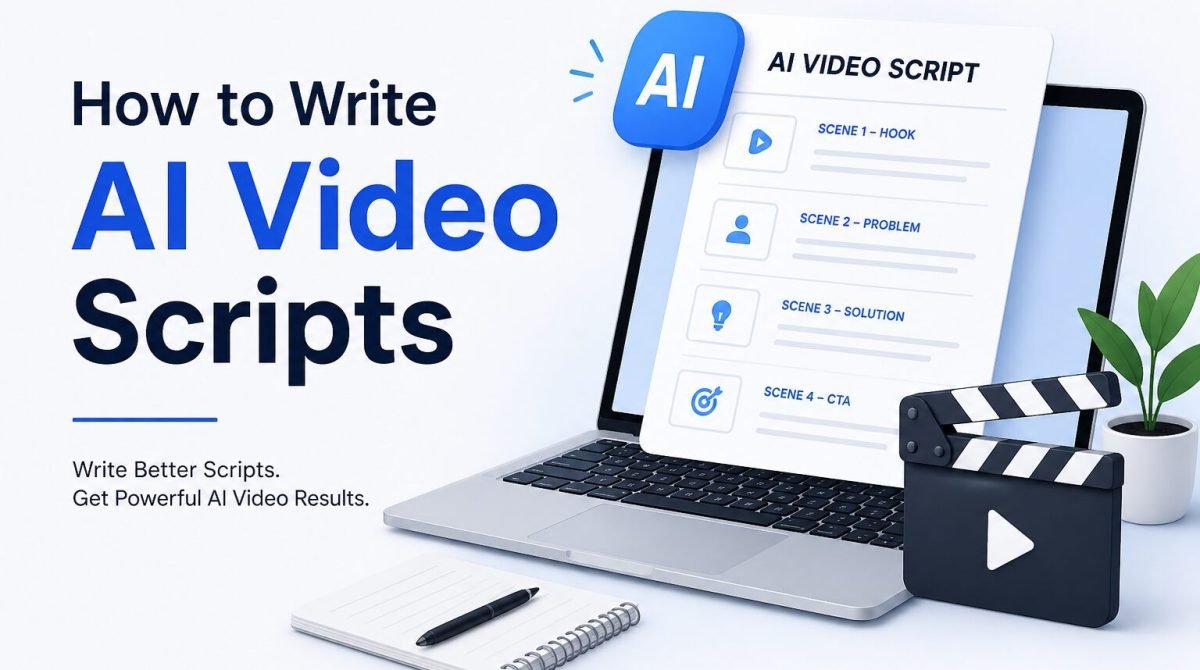
- Scene 1: Hook
- Scene 2: Problem
- Scene 3: Solution
- Scene 4: CTA
This makes the script easier to plan and also helps the AI tool process things better.
Step 4: Write Clear Prompts
This is where most people go wrong. AI tools need clarity, not guesswork.
Follow a simple structure:
Subject + Action + Environment + Style + Camera
Example:
“A young woman drinking herbal tea in a bright kitchen, morning light, calm mood, close-up shot”
The more specific you are, the better the output. Vague prompts usually lead to average results.
Step 5: Add Voiceover and Subtitles
Your voiceover should match what’s happening on screen. Keep it natural and easy to understand, no complicated lines.
Also, don’t ignore subtitles. A lot of people watch videos without sound, especially on social media. Short sentences work best here.
Step 6: Optimise for the Tool
Not all AI tools work the same way.
- Runway ML handles detailed prompts really well
- Synthesia is better for avatar-style videos
So, tweak your script depending on the tool. A small adjustment here can improve the final output quite a bit.
AI Video Script Formats
1. Short-Form Reel Script
This is ideal for Instagram Reels or YouTube Shorts, quick, sharp, and straight to the point.
Structure:
Hook → Problem → Solution → CTA
Example:
- Hook: “Still dealing with low energy?”
- Problem: “Your daily routine might be the reason.”
- Solution: “Try switching to a healthier lifestyle.”
- CTA: “Start today.”
Keep it fast-paced. You don’t have much time to grab attention here.
2. Explainer Video Script
This format works best when you want to explain something clearly, like a product, service, or concept.
Structure:
Problem → Insight → Solution → Benefits
Example:
- Problem: “Businesses often struggle with video production.”
- Insight: “Traditional methods take time and can be expensive.”
- Solution: “AI tools simplify the entire process.”
- Benefits: “You get faster and more efficient content.”
The idea is to build understanding step by step, without overcomplicating things.
3. Ad Script Format
Perfect for performance-driven videos where the goal is to convert.
Structure:
Hook → Product → Proof → Offer
Example:
- Hook: “Tired of slow video production?”
- Product: “Our AI solution helps you save time.”
- Proof: “Trusted by hundreds of brands.”
- Offer: “Get started today.”
This format is quite direct, and that’s the point. Keep it clear, focused, and action-oriented.
Writing Better Prompts for AI Video Generation
If your prompts are clear, your output will usually be better. It’s as simple as that.
A good way to structure your prompts is:
Subject + Action + Environment + Style + Camera
This keeps everything organised and easy for the AI to understand.
Examples:
- Cinematic: “A luxury apartment at sunset, golden light, aerial view”
- Product ad: “Skincare product placed on a marble table, soft lighting, close-up shot”
- Corporate: “Team meeting in a modern office, natural lighting, wide shot”
One more thing, try to keep your prompts consistent across different scenes. It helps maintain the same look and feel throughout the video, which makes the final result look more polished.
Tools for AI Video Script Creation
There are plenty of AI tools out there, but you don’t need to overcomplicate things. A few good ones can handle most of your workflow.
For script writing:
- ChatGPT
- Jasper AI
These tools are great for coming up with ideas, structuring your script, and even refining your messaging when you’re stuck.
For video creation:
- Runway ML
- Synthesia
They take your script and turn it into actual video content. Each tool works a bit differently, so you’ll need to tweak your script depending on what you’re using.
For editing:
Editing tools come in at the final stage. This is where you clean things up, add effects, fix timing, improve visuals, and make the video look more polished overall.
Why Choose Trigital Solutions for AI Video Production
Trigital Solutions is a dedicated AI video production company helping brands create content that actually performs, not just looks good. From concept to final delivery, everything is built around clear scripting, smart use of AI tools, and a strong understanding of what drives results.
Over time, the team has created 250+ AI videos for multiple brands, across industries like e-commerce, real estate, and healthcare. So this isn’t experimental work, they’ve already tested what works in real campaigns.
What Makes Trigital Solutions Different
- Proven experience in AI storytelling: It’s not just about generating visuals. The focus is on telling a story that keeps viewers engaged and drives action.
- Performance + SEO mindset: Every video is created with a clear goal, whether that’s clicks, leads, or conversions. The content is aligned with marketing objectives, not just creative output.
- End-to-end execution: You don’t have to juggle multiple vendors. From script writing and prompt creation to video generation and final edits, everything is handled in one place.
- Practical, no-nonsense approach: The process is straightforward. No overcomplication, just what works best for your brand and audience.
Services Offered
Trigital offers a wide range of AI video solutions, depending on your business needs:
- AI video ads for paid campaigns
- Social media reels for platforms like Instagram and YouTube
- Corporate explainer videos to simplify complex ideas
- Performance-driven creatives focused on conversions
- Training videos
- Product videos for showcasing features and benefits
Each type of video is planned with a clear objective in mind, so you’re not just creating content, you’re solving a specific business problem.
Benefits for Businesses
- Faster production cycles: What used to take weeks can now be done in days, sometimes even faster.
- Lower overall costs: Compared to traditional shoots, AI video production reduces expenses without cutting down on quality.
- Consistent output at scale: Need multiple videos every month? That’s actually manageable here.
- Better engagement and conversions: Since scripts are structured and performance-focused, the final videos tend to connect better with the audience.
Honestly, it just makes the entire content process smoother and more predictable.
Final Thoughts
AI video creation is growing fast, no doubt. But even with all these tools, the script still does most of the heavy lifting. If the script isn’t clear, the output won’t be either, it’s that simple.
A well-structured script helps you:
- Get better, more accurate results
- Keep your videos consistent
- Improve engagement and overall performance
The key is to keep things clear and straightforward. Don’t overcomplicate it. Write, test, see what works, and then refine. That’s how you get better.
It might take a few attempts in the beginning, and that’s normal. But once you understand how AI tools respond to good scripting, the whole process becomes much smoother, and honestly, quite effective for scaling your content.
FAQs
1. What is an AI video script?
An AI video script is a structured set of instructions that includes visuals, prompts, and voiceover to help AI tools generate videos accurately and consistently.
2. Why is scripting important in AI video creation?
Scripting ensures that the AI understands what to generate. A clear script improves video quality, consistency, and overall output.
3. What are the key elements of a good AI video script?
A strong AI video script includes a clear hook, detailed visual directions, simple voiceover, smooth transitions, and a strong call-to-action.
4. How do you write effective prompts for AI videos?
Use a structured format like: Subject + Action + Environment + Style + Camera. This helps AI tools generate more accurate visuals.
5. Which tools are best for AI video scripting and creation?
Popular tools include ChatGPT and Jasper AI for scripting, and Runway ML and Synthesia for video generation.

Vishal Soni is the founder of Trigital Solutions, with over 24 years of expertise in digital marketing, including SEO, paid media, AI-driven video solutions, and business growth strategies. An MBA from IMI, he has helped generate ₹500 crore in business for agencies and startups, earning a reputation as a trusted advisor and industry leader. As an AI video expert, Vishal combines cutting-edge technology with practical execution to drive impactful results. His hands-on experience and commitment to digital excellence make his insights highly valued across the industry.