
The EdTech industry is rapidly expanding, as students and professionals are shifting towards online learning. Learners nowadays expect easy access, visually interactive, multilingual, engaging, and video-based learning.
Meanwhile, EdTech organizations are also facing escalating demands to produce and update course material in a hurry. Traditional video production techniques have their limitations, such as high production costs, long production times, and manual processes, which can be challenging to scale across regions.
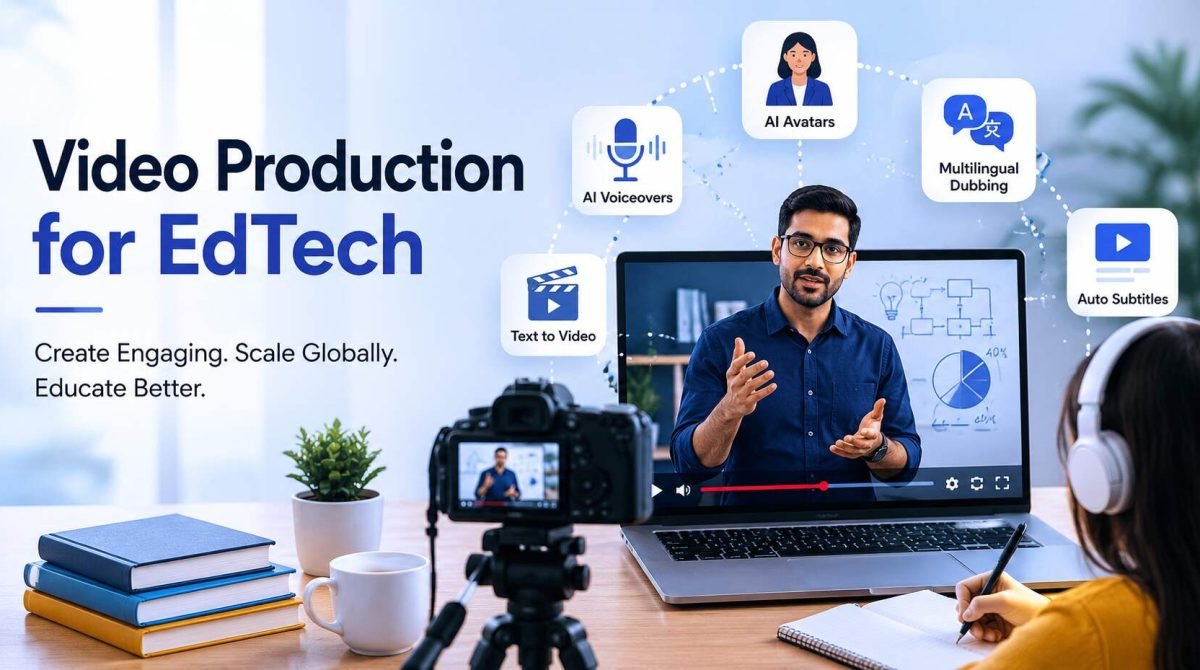
That’s where AI video production is changing the way of online education. AI is transforming the creation of high-quality educational videos with its capabilities, such as AI avatars, automated voiceovers, multilingual dubbing, and text to video, which enhance the video production process in terms of quality and efficiency.
This has led to an increase in the number of platforms using AI-powered video production in numerous global learning platforms that are now leveraging technology to scale course libraries, connect with learners from around the globe, and provide a uniform experience on the planet.
The Growing Demand for Scalable EdTech Content
Online education is no longer limited to a few developed markets. Learners from different countries, languages, and age groups are now actively consuming digital educational content every day. The rise of smartphones, affordable internet access, and remote learning has made online education more accessible than ever before.
This rapid growth has also created a major challenge for EdTech companies: scaling content production.
Modern learners expect:
- Video-first learning experiences
- Bite-sized lessons
- Mobile-friendly content
- Multilingual support
- Faster course updates
- Interactive explanations
Traditional video production often struggles to meet these expectations quickly. Recording instructors in studios, manually editing videos, creating subtitles, and localizing courses into multiple languages can significantly slow course launches.
For large EdTech brands operating globally, producing thousands of lessons manually becomes difficult to sustain. They need a faster and more scalable system that can support continuous content creation without compromising quality.
AI video production is helping solve exactly that problem.
What Is AI Video Production in EdTech?
AI video production refers to the use of artificial intelligence tools and automation technologies to create educational videos with minimal manual effort.
Instead of relying entirely on traditional filming processes, AI-powered platforms can generate videos using scripts, digital avatars, synthetic voiceovers, automated editing systems, and language translation tools.
In the EdTech space, AI video production is commonly used for:
- Course explainers
- Training modules
- Language learning videos
- Animated educational lessons
- Product tutorials
- Student onboarding videos
- Skill development programs
Some of the most common AI video technologies used in education include:
- AI Avatars: Digital instructors that can present lessons naturally on screen without requiring physical shoots.
- Text-to-Video Systems: AI tools that convert written scripts into visual educational videos automatically.
- AI Voiceovers: Human-like voices generated in different accents and languages.
- Auto Subtitling: Automatic caption generation for accessibility and multilingual learning.
- AI Translation and Dubbing: Using an AI dubbing tool, educators can localize videos into various languages without reshooting the original content.
- AI Editing Tools: The biggest advantage is speed. EdTech companies can now create large volumes of educational content much faster compared to traditional production workflows.
Why EdTech Companies Are Adopting AI Video Production
The growing adoption of AI video production in education is driven by both operational and business needs. EdTech companies are realizing that AI is not just a trend. It is becoming an essential part of scalable learning infrastructure.
Faster Content Creation
Educational platforms need to release courses continuously to stay competitive. AI tools reduce production timelines dramatically by automating scripting support, editing, subtitling, and voice generation.
Instead of spending weeks creating one course, companies can now develop multiple learning modules within days.
Lower Production Costs
Traditional shoots involve studios, cameras, instructors, lighting setups, editors, and reshoots. AI video production minimizes many of these expenses.
For growing EdTech businesses, this makes large-scale content production far more cost-effective.
Multilingual Course Expansion
One of the biggest advantages of AI video production is localization. Courses can be translated into multiple languages quickly using AI dubbing and subtitles.
This allows EdTech companies to enter new international markets without rebuilding entire courses from scratch.
Consistency Across Learning Modules
AI avatars and automated systems maintain consistent presentation styles across thousands of videos. This helps platforms create uniform learning experiences for students worldwide.
Faster Course Updates
Educational information changes constantly, especially in technology, healthcare, finance, and software training. AI-powered systems make it easier to update scripts and regenerate videos without expensive reshoots.
How AI Video Production Helps Scale Global Learning Platforms
Scaling educational content globally requires more than just creating videos. It involves speed, adaptability, accessibility, and localization. AI video production supports all of these areas simultaneously.
- AI systems can help EdTech businesses get courses up and running in multiple countries more quickly. AI systems simplify translation and localization. One course in India can be used in Europe, the Middle East, or Latin America without using different production cycles
- AI also helps with mobile-first learning methods. Short-form video learning is growing in popularity, particularly with younger generations and working professionals.
- Another important advantage is scalability for corporate training. AI-generated educational videos are an effective way for businesses with employees across different countries to provide consistent compliance training.
- AI video production also supports microlearning, where complex topics are broken into short, easy-to-understand modules. This improves learner engagement while enabling platforms to efficiently create large content libraries.
As global demand for digital education grows, AI enables EdTech companies to scale without a proportional increase in production costs.
Key Use Cases of AI Video Production in EdTech
AI video production is being used across various educational sectors and learning models.
K-12 Learning Platforms
School-focused learning apps are using AI-generated explainers, animated lessons, and multilingual educational videos to simplify complex subjects for younger students.
Interactive visuals and AI narration make learning more engaging and easier to understand.
Higher Education and Universities
Universities are increasingly adopting AI video tools for hybrid learning environments. Professors can create recorded lectures, digital classroom modules, and online certification content efficiently.
AI also helps institutions provide learning material to international students in multiple languages.
Corporate Training Platforms
Corporate learning platforms use AI video production for employee onboarding, compliance training, leadership development, and technical education.
Since training content often requires frequent updates, AI-based workflows save significant time and cost.
Test Preparation Platforms
Competitive exam coaching platforms rely heavily on video-based education. AI tools help these companies scale lesson creation quickly while maintaining consistency across batches and subjects.
Healthcare and Technical Education
Medical and technical education often involves complex concepts that are easier to explain visually. AI-generated animations and instructional videos simplify difficult topics and improve learner understanding.
AI Video Features That Are Transforming Online Education
Several AI-powered video features are reshaping how educational content is created and consumed.
AI Avatars as Digital Instructors
AI avatars can act as virtual educators capable of delivering lessons naturally. These avatars provide consistent delivery and can appear in multiple languages without requiring repeated filming.
Human-Like AI Voiceovers
Modern AI voice technology sounds increasingly natural and supports multiple accents and languages. This improves the learning experience for international students.
Automatic Subtitles and Captions
Captions improve accessibility and make educational content easier to consume in different environments.
Real-Time Translation
AI translation tools are helping platforms localize educational videos rapidly, making global expansion much easier.
Personalized Learning Experiences
AI systems can eventually adapt video recommendations and lesson structures based on individual learner behavior and progress.
Interactive Learning Modules
Some AI-powered platforms are integrating quizzes, summaries, and interactive learning elements directly into educational videos.
Benefits of AI Video Production for Students and Learners
The impact of AI video production is not limited to EdTech companies alone. Students also benefit significantly from these innovations.
- Better Learning Engagement: Visual learning combined with AI-driven narration improves content retention and understanding.
- Learning in Native Languages: Students can access educational content in their preferred language, improving accessibility and comprehension.
- Faster Access to Updated Information: AI-powered workflows allow educational platforms to update outdated lessons quickly.
- Flexible Learning: Students can learn anytime and anywhere through mobile-friendly video formats.
- Improved Accessibility: Subtitles, voiceovers, and multilingual support make education more inclusive for learners worldwide.
- Simplified Complex Topics: Animations and AI-generated explainers help break down difficult subjects into easier concepts.
How Leading EdTech Brands Are Using AI Video Production
Many leading educational platforms are already integrating AI into their content production strategies.
Global learning companies are using AI tools to create multilingual courses for international learners. Some platforms use AI avatars to maintain consistent instructor delivery across thousands of lessons.
Others are leveraging AI dubbing and subtitling to localize educational content rapidly for different markets.
Corporate learning platforms are also using AI-generated training videos to onboard employees across global offices efficiently.
The common goal across all these companies is scalability. AI video production allows them to create more educational content, reach wider audiences, and reduce operational bottlenecks.
Why Choosing the Right AI Video Production Company Matters
With the rise of AI-powered learning, partnering with the right production company becomes essential for EdTech businesses aiming to go global. Beyond just AI tools, educational brands need a video production company that understands instructional storytelling, multilingual learning experiences, learner engagement, and scalable content workflows.
This is where Trigital Solutions stands out as a preferred AI video production company for EdTech and digital learning brands. Trigital has experience in creating educational videos using AI, multilingual content, AI avatars, and scalable production systems, which enables businesses to generate high-quality learning content in a faster and more efficient way for global audiences.
From online course modules and explainer videos to corporate learning and educational marketing assets, Trigital Solutions supports brands in building modern, video-first learning ecosystems powered by AI.
Future of AI Video Production in EdTech
The future of AI in education is very promising.
In the near future, AI-driven learning experiences will be even more engaging and customizable. AI tutors that can interact with students as they learn, adaptive video lessons according to the learner’s performance, and virtual classrooms that offer a more immersive experience with AI assistance could all be possible.
The future of digital education is set to be shaped by AI, personalization, and video-based learning, which will continue to grow and transform.
Early implementation of AI video production by EdTech companies can give them a competitive edge in scalability, reach, and efficiency.
Conclusion
AI video production is transforming how educational content is created, distributed, and scaled across the world.
For EdTech companies, it offers a faster, more cost-effective, and highly scalable approach to course development. From multilingual localization and AI avatars to automated editing and personalized learning experiences, artificial intelligence is helping educational platforms meet the growing demands of global learners.
As online education continues expanding worldwide, AI-powered video production is becoming a key driver of innovation in the EdTech industry.
The future of education is not just digital anymore. It is intelligent, scalable, and increasingly powered by AI.
FAQs
1. What is AI video production in EdTech?
AI video production in EdTech refers to the use of artificial intelligence technologies such as AI avatars, text-to-video generation, automated voiceovers, subtitles, dubbing, and video editing tools to create educational content faster and more efficiently.
2. How does AI video production help EdTech companies scale content?
AI video production enables EdTech companies to create, update, and localize large volumes of educational content quickly. It reduces production time, lowers costs, and allows platforms to expand course offerings across multiple regions and languages.
3. Can AI-generated educational videos replace traditional video production?
AI-generated videos can significantly reduce the need for traditional production in many cases, especially for course explainers, training modules, and multilingual content. However, some educational content may still benefit from human instructors and customized production approaches.
4. Is AI video production cost-effective for EdTech businesses?
Yes. AI video production reduces expenses related to filming, studio rentals, editing, voice recording, and reshoots. This makes large-scale educational content creation more affordable and sustainable for EdTech companies.
5. What types of educational content can be created using AI video?
AI video can be used to create course lessons, explainer videos, language-learning modules, product tutorials, onboarding videos, animated educational content, certification programs, and training materials.

Vishal Soni is the founder of Trigital Solutions, with over 24 years of expertise in digital marketing, including SEO, paid media, AI-driven video solutions, and business growth strategies. An MBA from IMI, he has helped generate ₹500 crore in business for agencies and startups, earning a reputation as a trusted advisor and industry leader. As an AI video expert, Vishal combines cutting-edge technology with practical execution to drive impactful results. His hands-on experience and commitment to digital excellence make his insights highly valued across the industry.