
250+ AI Video Ads Produced for India's Biggest Brands - Here's Everything We Learned
The Beginning of Something We Didn't Fully Understand
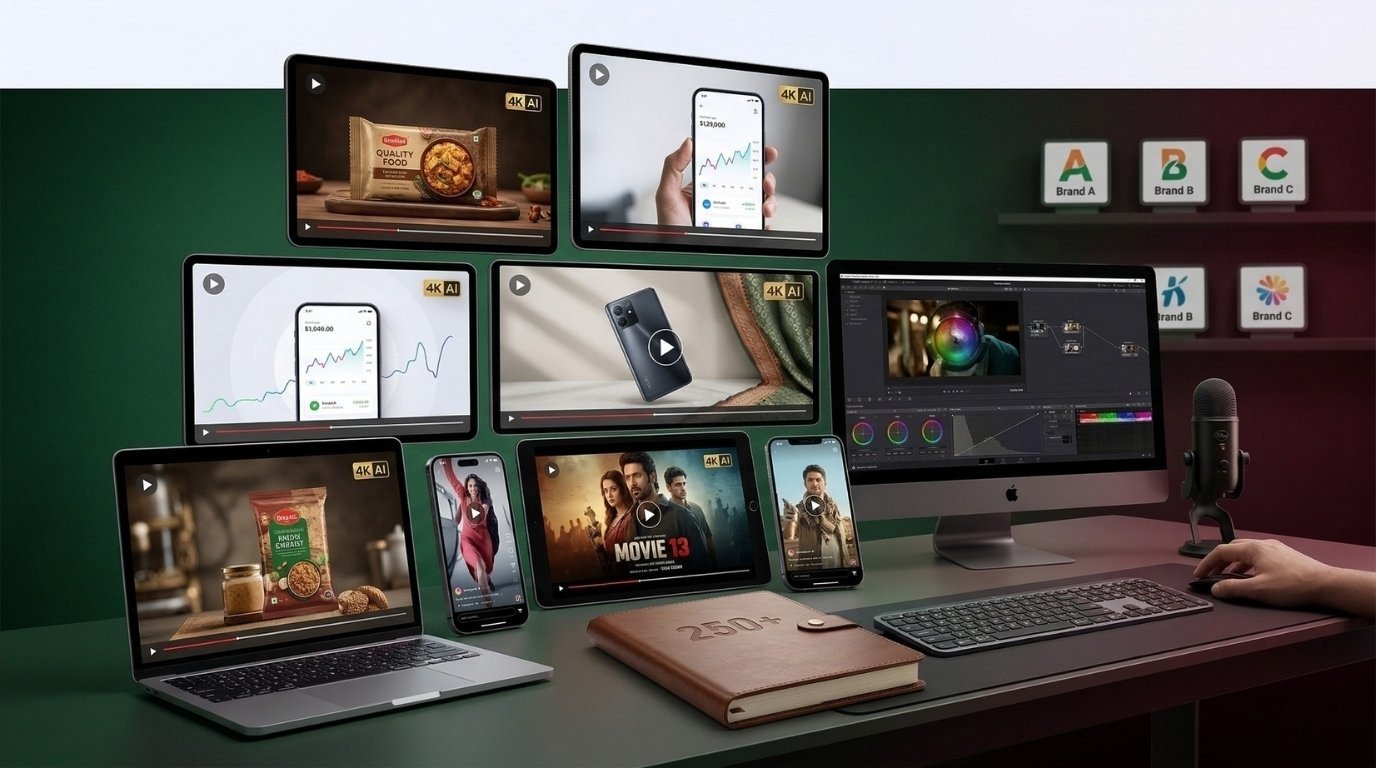
Not long ago, a high-quality video ad required a director, a crew, a studio, talent, a post-production team, and a budget that could stretch into lakhs before a single frame was approved. Timeline? Three to eight weeks — if everything went right.
Then AI changed the equation.
When we first started, there was no playbook—just evolving tools and the belief that we could deliver broadcast-quality ads in days at a fraction of the cost.
Today, we've produced 250+ AI video ads for India's leading brands across FMCG, Fintech, Consumer Electronics, and B2B. We've mastered every format, from Instagram Reels to OTT.
After 250 videos, we've moved past the guesswork. This article shares our journey: the wins, the failures, and the hard truths of AI video production.
Who We Are and Why This Matters
Trigital Solutions is an AI video production company. We sit at the intersection of creative strategy and AI execution — which means we are not just prompt engineers, and we are not just creative directors. We are both, simultaneously, on every project.
We entered this space because we saw a genuine gap: brands needed more video content than traditional production could ever sustainably deliver. The demand for video — across social, digital, OTT, performance marketing, and e-commerce — had outpaced the industry's ability to produce it affordably.
250 videos later, here is what that revolution actually looks like from the inside.
The Landscape: Why AI Video Is Not Optional Anymore
The numbers are clear. Short-form video now dominates every major platform. Brands need 15-second cuts, 30-second cuts, 6-second bumpers, square formats, vertical formats, landscape formats — often for the same campaign, the same week. Add multilingual requirements across Hindi, English, Tamil, Telugu, and regional languages, and traditional production simply collapses under the weight of demand.
| Dimension | Traditional Production | AI Video Production |
|---|---|---|
| Average Timeline | 3 – 6 weeks | 2 – 7 days |
| Cost Structure | High fixed cost per video | Scalable, lower per unit |
| Format Variants | Each variant = new cost | Variants at minimal incremental cost |
| Language Variants | Separate production per language | Single workflow, multiple languages |
| Revision Flexibility | Limited (crew/studio dependent) | High (iterate quickly) |
Learn more about what AI video production is and why it's transforming the industry.
Core Lessons: What 250 Campaigns Taught Us
Over 250 campaigns, we've distilled eight core lessons that separate successful AI video production from generic output. Each lesson represents real failures, hard-won solutions, and systematic improvements that now define how we work.
The Script Is Everything — AI Amplifies Whatever You Give It
The Issues We Faced
In our earliest projects, we approached AI tools the way most people approach a search engine — type something in, see what comes out, refine from there. The results were exactly what you'd expect: generic, lifeless, and disconnected from any brand identity.
The core problem was that we were writing briefs for AI the way you'd brief a human director — big-picture creative direction, mood references, emotional outcomes. The AI had no idea what to do with that. It produced something technically coherent but creatively hollow.
We were writing for imagination. AI needed instructions.
Specific problems encountered:
- Vague prompts like 'show a confident man walking through a city' produced generic stock-footage-level output
- Scripts written for human direction contained too much subtext and too little visual specificity
- First-cut outputs required extensive rework, wiping out the speed advantage entirely
- Output quality varied wildly between projects because no standardised scripting method existed
How We Overcame It
The turning point was treating scriptwriting for AI as its own craft — completely separate from traditional scriptwriting. We built an internal scripting framework specifically for AI video production.
Every AI video script now includes:
- Scene-by-scene visual breakdown with precise spatial descriptions
- Explicit emotion and energy cues per scene
- Brand tone markers embedded in the script language
- Pacing guidance mapped to the platform format
- Visual reference anchors that set the AI's exact creative register
Instead of 'a confident man walking through a city,' the brief now reads: 'A well-dressed man in his early 30s, sharp dark kurta, walking at a decisive pace through glass corridors of a modern office building — warm overhead lighting, minimal background movement, close-up on his expression as he turns to camera.'
The difference in output quality was immediate and transformational.
Every Brand Has a Visual Language — AI Must Learn It, Not Replace It
The Issues We Faced
In our early projects, we made a costly assumption: that high-quality AI output was universal. That if a visual looked polished, it would work for any brand we pointed it at.
It didn't. Everything looked vaguely premium but specifically nothing. Brand identity — the thing that makes a viewer recognise an ad before the logo appears — was completely absent.
How We Overcame It
We built what we now call Brand Visual Dictionaries — internal documents created for every client before a single prompt is written.
A Brand Visual Dictionary captures:
- Dominant colour palette and their emotional register
- Lighting mood (warm vs cool, hard vs diffused)
- Motion energy (fast cut vs slow reveal, kinetic vs contemplative)
- Visual metaphors the brand uses and actively avoids
- Reference aesthetics from existing brand material
- Forbidden visual elements that clash with brand identity
Before generating any output, every prompt passes through this dictionary.
Industry Context Changes Everything
The Issues We Faced
In our first fifty projects, we applied a generalized production approach across categories. It worked adequately, but not exceptionally.
The problem crystallized when we started working across radically different industries in the same month—a credit card ad, a skincare product launch, a B2B platform video, and a hardware brand video.
The core conflict:
- Visual logic that builds trust for a bank creates corporate coldness for a beauty brand
- Energy that excites a D2C consumer confuses a B2B procurement decision-maker
- Premium aesthetics in fintech (clean, data-forward) clash with premium aesthetics in lifestyle (warm, textural, human)
- Compliance visual requirements in financial services are non-existent in FMCG — yet we were using the same review criteria for both
How We Overcame It
We built industry-specific production frameworks — separate prompt structures, reference libraries, review criteria, and output benchmarks for each vertical.
| Vertical | Visual Priority | Key Requirement |
|---|---|---|
| Fintech / Banking | Trust & Clarity | Compliance, no ambiguity |
| Beauty / Personal Care | Aspiration & Sensory Appeal | Texture, tone accuracy |
| B2B / Industrial | Scale & Authority | Expertise, reliability |
| Lifestyle / Home | Warmth & Craft | Occasion, human touch |
| Consumer Electronics | Innovation & Precision | Tech clarity, clean UI |
Each industry track has its own prompt templates, mood board libraries, and post-production quality checklists. No two verticals share the same framework.
For B2B businesses specifically, check out our guide on AI video for B2B businesses.
Human Creative Direction Is Non-Negotiable
The Issues We Faced
The most persistent misconception — from clients, from the market, and occasionally from our own team in early days — was that AI video made humans largely redundant in the creative process. Put in a brief, AI produces the output, ship the ad.
This is not only wrong. It is the fastest way to produce mediocre AI video at scale.
What happened when we reduced creative oversight:
- Technically capable, creatively empty outputs — videos that looked like ads but felt like nothing
- Brand voice evaporated in every direction we generated
- Outputs were professionally assembled but emotionally disconnected from the audience
- Content was indistinguishable from AI-generated content made by anyone else
How We Overcame It
We made a definitive structural decision: human creative direction would never be reduced, only evolved. What changed was not the presence of human creativity but its focus.
What the human creative team now owns exclusively:
- Strategic brand interpretation for every project
- Emotional storytelling architecture — the journey, not just the execution
- AI output curation: selecting the strongest directions from generated material
- Direction of the refinement loop between initial output and final deliverable
- Final quality review that no AI tool can replicate
Our creative directors no longer spend time on production logistics or vendor management. They spend 100% of their energy on strategy, brand interpretation, and output elevation. The result is AI production with a human soul.
Speed Is the Superpower — But Only If Your Process Is Tight
The Issues We Faced
Speed is the core promise of AI video: two to seven days versus three to six weeks. It is real. But in our first sixty to seventy projects, we were not consistently delivering on it — and the reason had nothing to do with the AI tools.
The bottleneck was us.
The internal chaos we were operating in:
- No standardised brief format — every project arrived differently
- Approval stages were undefined and verbal
- Revision requests had no structure or scope limits
- Team handoffs were inconsistent and information was lost between stages
- Generating fifty outputs in a day is useless if nobody has a framework to evaluate or approve them
How We Overcame It
We built a production system from the ground up — a repeatable, documented workflow with defined stages, handoffs, review gates, and approval milestones.
Our 5-Stage Production System:
- Creative Alignment — brand brief, visual dictionary, and script approval
- Production Brief — detailed scene-by-scene AI brief with visual references
- Generation and Curation — AI output generation, team curates to top 3 directions
- Client Review — structured presentation with defined feedback format
- Final Delivery — approved direction refined and packaged for all formats
Each stage has a defined owner, a defined output, and a defined sign-off requirement. Nothing moves forward without completion of the prior stage.
Result: first-cut presentation within 48–72 hours of approved script. Final delivery, including all format variants, within 5–7 business days of project kick-off. Consistently.
Revision Culture Kills AI Video Projects
The Issues We Faced
One of the most unexpected challenges of AI video production is what we now call Revision Drift — the tendency to treat AI's generation speed as a licence for unlimited creative exploration.
The thinking: 'AI can generate another version quickly, so let's just try this, and this, and this...' Before long, a project that should deliver in five days has consumed fifteen, with twenty-five outputs generated and none approved.
The cascading problems of Revision Drift:
- Clients presented with too many options lose the ability to make decisions
- Creative direction drifts further from the original brief with each round
- Team morale deteriorates with endless regeneration cycles
- Late-stage course corrections are expensive even when individual generations are fast
- No brief = no objective standard to evaluate output against
How We Overcame It
We moved the entire alignment process to before production begins — and made it non-negotiable.
Pre-Production Alignment Session (mandatory for every project):
- Client approves three to five reference videos that define visual territory
- Tone, energy, 'must haves,' and 'must avoids' are documented in writing
- Format requirements are specified before generation begins
- A Creative Brief Document is signed off by the client — this becomes the objective benchmark for all reviews
- Revision requests outside the brief are flagged as scope additions, not corrections
Outcome: average revision rounds dropped from 5–7 per project (early phase) to 1–2 (current). Delivery timelines became predictable. Client satisfaction scores improved because the work arriving at review aligned with what they had asked for.
Multilingual and Multi-Format Is Where AI Video Truly Shines
The Issues We Faced
In our early projects, we were largely producing single-language, single-format ads. Useful, but not transformative. Traditional production could do the same at higher cost and longer timelines.
We were underutilising AI's most unique and commercially powerful capability: scale.
What we realised too late:
- Federal Bank serving customers across states needs regional-language trust messaging — not just an English ad
- Indiamart connecting buyers and sellers across India's linguistic diversity needed Hindi, Tamil, Telugu, and English variants simultaneously
- Regional FMCG brands needed the same creative in different formats for different platforms within the same campaign week
- Traditional production's answer to this requirement is either a massive budget or a compromised strategy
How We Overcame It
We built a Variant Production Framework — a system for producing a core master AI video and efficiently scaling it across all required languages, formats, and lengths without starting from scratch.
The framework produces from one production cycle:
- Hindi, English, Tamil, and Telugu language versions
- 6-second, 15-second, and 30-second duration cuts
- Square (1:1), landscape (16:9), and vertical (9:16) aspect ratios
- Platform-specific versions for Instagram, YouTube, OTT, and performance channels
Scripts are structured so voiceover swaps don't require visual regeneration. Visual compositions are built to work across aspect ratios. Timing is mapped to accommodate natural length differences between language variants.
What used to require four separate production cycles now requires one.
For social media content specifically, explore our AI video production for social media and AI Instagram Reels production services.
What AI Video Still Cannot Do — And We Are Honest About It
The Issues We Faced
Credibility is built on honesty — including honesty about limitations. In early client conversations, there was a temptation to oversell AI video as a complete replacement for all forms of video production. It isn't, and overselling it created problems.
Situations where AI video fell short:
- Hyper-realistic human emotional performances — clients expected AI to replicate the nuance of real actors in close emotional detail
- Specific physical product integration — exact packaging, textures, and label details that needed to match real-world product shots
- Complex narrative storytelling with multiple interacting human characters in realistic environments
- Premium brand categories where real-shoot production value is itself a brand equity signal
- When we didn't have these conversations early enough, we wasted time, budget, and trust
How We Overcame It
We built an honest qualification framework — a set of questions asked at brief stage to determine whether a project is best served by AI video, a hybrid approach, or traditional production.
When a project falls into the second category, we say so. We recommend the right solution — sometimes AI-led, sometimes hybrid, sometimes traditional. We have lost short-term revenue by doing this. We have gained long-term client trust worth far more.
Compare the differences in our article: AI video production services vs traditional video production services.
The Evolution: From Video #1 to Video #250
Our growth as a studio happened in three distinct phases. Looking at them together reveals not just what we built, but why it needed to be built in that order.
Phase 1 — Experimentation (Videos 1–50)
This was the period of high excitement and inconsistent output. We were testing tools, exploring what was possible, and learning by doing. Every project was genuinely novel. Output quality varied enormously — some videos were outstanding, others were hard lessons. Workflows were informal, processes were intuitive.
What this phase gave us was something no planning can replace: direct, unfiltered experience with the medium. Every failure shaped the frameworks of the phases that followed.
Phase 2 — Systematisation (Videos 51–150)
This is the phase where Trigital Solutions became a real production studio. We built the processes, the frameworks, the Brand Visual Dictionaries, the onboarding systems. We built internal prompt libraries organised by category, mood, and brand type. We defined production stages and team roles explicitly.
Quality became consistent. Timelines became reliable. Client feedback became less reactive and more constructive. We started working on multi-brand, multi-format campaigns — and actually delivering them with confidence.
Phase 3 — Scale and Specialisation (Videos 151–250)
By this phase, we had moved from studio to strategic partner. Clients were returning for ongoing content programmes, not just individual campaigns. We were handling complex multilingual, multi-format deliverables as routine operations.
We also developed genuine category expertise. Our work for financial services clients looks different from our beauty brand work — not because we use different tools, but because we have built distinct creative and strategic depth in each vertical.
The shift from vendor to strategic partner is the most significant evolution of this phase.
What the Numbers Show
The story of 250 AI video ads can be told in metrics that reflect the direct impact of the lessons above.
| Metric | Result |
|---|---|
| Videos Produced | 250+ across the full portfolio |
| Brands Served | 50+ major brands across 10+ industry verticals |
| First-Cut Delivery | 48 – 72 hours from approved script |
| Full Delivery Timeline | 5 – 7 business days from project kick-off |
| Speed vs. Traditional | 3 – 5x faster than traditional production |
| Languages Supported | 100+ |
| Format Variants | 6-sec · 15-sec · 30-sec in landscape · portrait · square |
| Revision Rounds | Reduced from avg. 5–7 (early) to 1–2 (current) |
These numbers are a consequence of the lessons above — not despite the failures we encountered, but because of them.
What's Coming Next
The AI video production landscape in the next 12 to 24 months will move faster than anything we have seen in the last two years. Based on what we are already seeing at the frontier, three capabilities are arriving that will fundamentally change what's possible.
Real-Time Personalisation at the Ad Level
Different visual content served to different audiences based on behaviour, geography, and context is no longer theoretical — it is a near-term reality. Brands that build AI video infrastructure now will be positioned to activate personalisation at scale when the platforms make it available.
AI Brand Avatars and Spokesperson Content
Consistent, on-brand, multilingual digital presenters are moving from experimental to practical. For brands with high-frequency content requirements, this represents a step-change in production economics — a single brief producing spokesperson content across five languages and eight formats simultaneously.
Learn more about UGC videos and how AI is transforming user-generated content.
Interactive and Adaptive Video Formats
Content that responds to viewer input, creates branching narratives, and adapts in real time is the next creative frontier. AI is the only production method that makes interactive personalised video economically viable for most brands.
At Trigital Solutions, we are investing in all three capability areas — not because they are interesting trends, but because the brands we work with will need them. We intend to be ready before they have to ask.
What This Means for Your Brand
250 videos taught us one thing above everything else: AI video production is not the future of advertising. It is the present — and brands that move now will own the next five years.
The question is no longer whether AI video works. It works. We have 250 data points that prove it, across brands that Indian consumers engage with every day.
The question is whether your brand is building the infrastructure, the relationships, and the creative capability to make AI video a strategic asset — or whether you will be catching up two years from now.
Ready to Transform Your Video Strategy?
If you want to explore what AI video can do for your brand — honestly, specifically, and without the hype — let's talk.
Explore Our AI Video Production Guide