
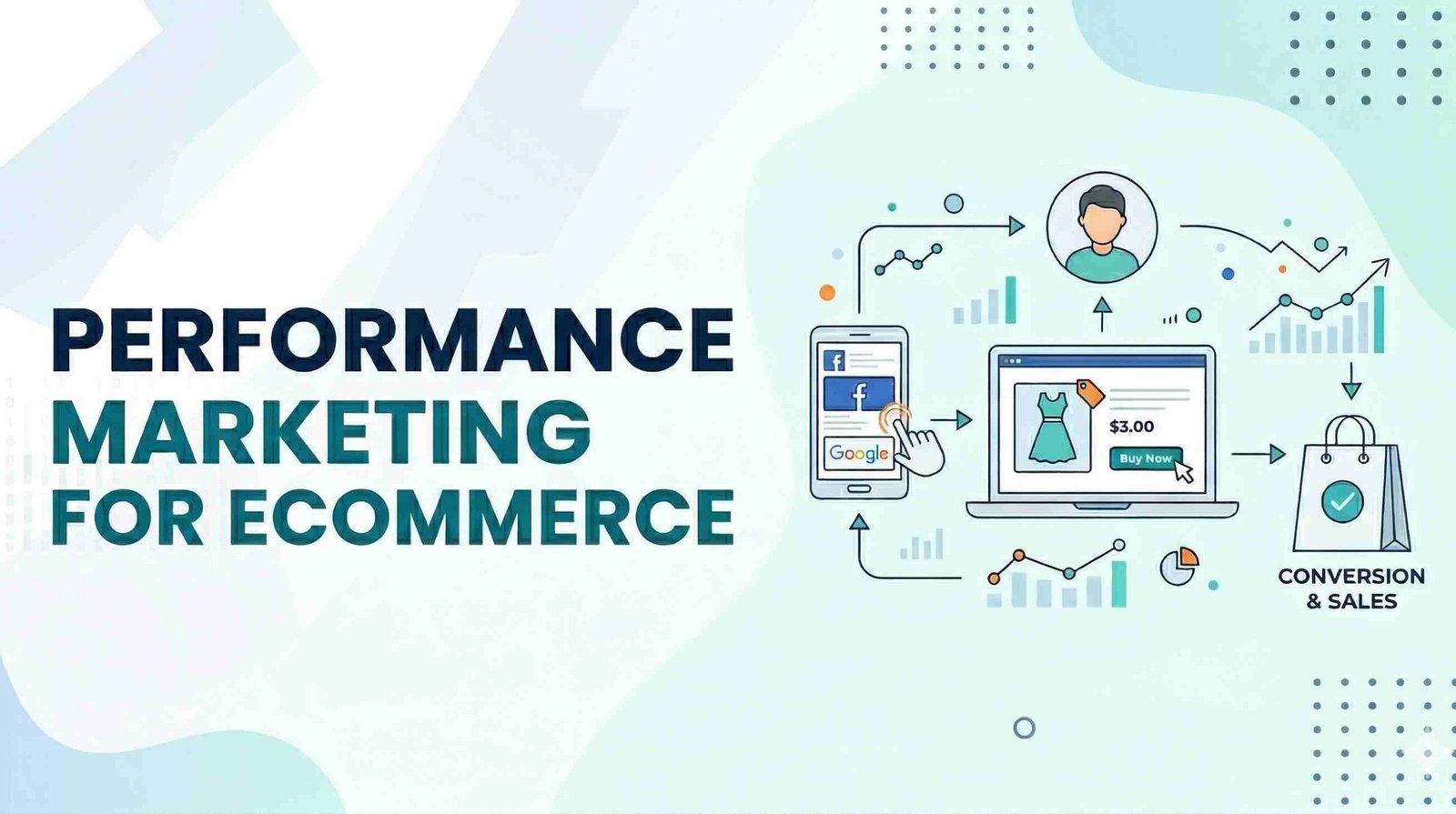
If you’re running an E-commerce business right now, you already know how brutal the competition has gotten. Every category is crowded. Ad costs are climbing. And customers have more choices than ever. Simply having a good product and a decent website isn’t enough anymore — you need a marketing engine that actually converts spend into revenue, predictably and repeatedly.
That’s what performance marketing is. And when done right, it’s the single most powerful growth lever available to E-commerce brands today.
This guide covers everything, what E-commerce performance marketing actually means, which channels work, how much to spend, how to measure results, and how to build a strategy that scales. No fluff, no theory for the sake of it. Just what works.
What Is Performance Marketing?
Performance marketing is simple: you pay only for results—a click, a lead, or a sale. Not impressions. Not reach. Actual outcomes.
Unlike traditional advertising, where you spend upfront and hope it drives sales, performance marketing ties every rupee to a measurable return. You know exactly what you’re spending, what you’re getting, and what’s working.
For E-commerce, this changes everything. You can clearly see which campaigns are profitable and which aren’t—and make decisions instantly. No guesswork. No wasted budget.
The 4 Core Pillars:
- Pay for results, not exposure: Optimize for CPA and ROAS—not vanity metrics.
- Measure in real time: Track clicks, conversions, and revenue as they happen.
- Scale what works: Increase spend only on profitable campaigns. Cut the rest.
- Diversify channels: Combine search, social, email, and affiliates for stable growth.
Performance Marketing vs. Traditional Marketing: The Real Difference
| Traditional Marketing | Performance Marketing | |
| What you’re paying for | Potential to be seen | Actual results |
| Payment model | Upfront, fixed cost (CPM) | Pay per action (CPC/CPA) |
| How you measure success | Impressions, estimates | ROAS, revenue, CPA |
| When you optimise | After the campaign ends | In real time, continuously |
The shift is simple but profound: traditional marketing is about reach, performance marketing is about return.
The Channels That Actually Drive E-commerce Revenue
Google Search & Shopping Ads — Your Highest-Intent Channel
When someone searches “buy wireless earphones under ₹3,000” on Google, they’re not browsing — they’re ready to purchase. That’s the magic of search. You’re not interrupting someone’s day; you’re showing up at exactly the moment they’re looking for what you sell.
Google Shopping ads are particularly powerful for E-commerce. Your product image, price, brand name, and ratings appear right in the search results — before the user even clicks into a website. The result is highly qualified traffic with strong purchase intent.
Well-optimised Shopping campaigns typically deliver a ROAS of 4x–8x. The blended Google Ads benchmark sits around 3.68x. It’s not the flashiest number, but it’s consistent and scalable — the foundation of most successful E-commerce marketing strategies.
Meta Ads (Facebook & Instagram) — Where Demand Gets Created
Google captures the demand that already exists. Meta creates it.
Nobody opens Instagram planning to buy a new skincare product. But a well-timed, well-targeted ad can make them want one within seconds. That’s the power of Meta — it reaches people based on who they are and what they’re interested in, not just what they’re searching for.
For fashion, beauty, home goods, food, lifestyle products — basically anything visual — Meta is often the single biggest revenue driver. Its targeting capabilities remain unmatched: demographics, interest groups, behavioral signals, lookalike audiences built from your best customers.
Meta accounts for around 68% of total ad spend among E-commerce brands — that dominance exists for a reason. Average ROAS for prospecting campaigns runs about 2.79x, but retargeting on Meta regularly hits 8x–15x because you’re reaching people already familiar with your brand.
Retargeting — Your Highest-Return Activity
Of everything in performance marketing, retargeting consistently delivers the strongest ROAS. You’re not introducing yourself to strangers — you’re following up with people who already showed interest. They visited your site. They viewed a product. They added to cart and left.
Dynamic retargeting takes this further by automatically showing each user the exact products they viewed. Someone who looked at a red running shoe sees ads for that specific shoe. Someone who checked out a kitchen appliance sees that appliance. The personalisation dramatically improves click-through and conversion rates.
Retargeting campaigns regularly hit ROAS of 10x or higher. The limitation is audience size — you can only retarget people who’ve already visited. But within that limitation, the return is exceptional. Always build and fund your retargeting properly before aggressively scaling prospecting spend.
Email Marketing & Automation — The Channel Everyone Underestimates
Email generates some of the highest ROI of any marketing activity, and most E-commerce brands don’t treat it seriously enough. The key is automation — setting up flows that trigger based on customer behaviour and run continuously without ongoing effort.
The essentials: abandoned cart sequences (typically 3 emails over 24–72 hours), browse abandonment emails, post-purchase follow-ups, win-back campaigns for lapsed customers, and personalised product recommendations based on purchase history.
When your email program is properly connected to your ad attribution data — knowing which campaigns brought in which customers — you can build hyper-personalised communication that dramatically improves repeat purchase rates and customer lifetime value.
WhatsApp Marketing — India’s Most Powerful Direct Channel
If you’re selling to Indian customers, WhatsApp isn’t just a messaging app — it’s where your customers actually spend their time. With over 500 million active users in India alone, WhatsApp marketing has become one of the most direct, personal, and high-converting marketing channels available to E-commerce brands operating in this market.
What makes WhatsApp different from every other channel is the open rate. Email averages 20–25% open rates on a good day. WhatsApp messages routinely see open rates of 90–98%. When you send a message to a customer on WhatsApp, they almost always read it. That’s a level of attention no other channel comes close to matching.
Affiliate Marketing — Performance-Based Reach Expansion
Affiliates promote your products in exchange for a commission on sales they generate. Coupon sites, review blogs, content creators, influencers with engaged audiences — all can drive real revenue on a pure pay-for-performance model. No sale, no cost.
The appeal for E-commerce brands is obvious: you’re leveraging existing audiences and established trust without upfront media spend. When managed well, affiliate programs scale effectively as successful partners increase their promotional activity.
Industry Benchmarks for 2025–2026
Understanding where the industry sits helps you evaluate your own performance honestly.
Google Ads:
- Average Shopping ad CPC: ~₹55 (43% cheaper than standard search)
- Google Search ad conversion rate: 2.81% across E-commerce
- Shopping ad conversion rate: 1.91% overall; apparel reaches 3.99%
- Blended Google ROAS benchmark: 3.68x (targeting 4x–8x on well-optimised campaigns)
Our Benchmarks:
- Shopping campaigns consistently optimized for 4.5x–7x ROAS
- High-intent keyword campaigns achieving 3.5%–5%+ conversion rates
- CPC efficiency improved by 15–30% through smart bidding + feed optimization
- Advanced segmentation delivering higher AOV-driven ROAS scaling
Meta Ads:
- Average CPC: ~₹90
- Average CPM: ₹1,140 (peaks above ₹2,100 during Diwali/Q4)
- Average E-commerce conversion rate: 1.57%
- Average ROAS: 2.79x for prospecting, 8x–15x for retargeting
Our Benchmarks:
- Prospecting campaigns scaled to 3x–5x ROAS using creative-first strategy
- Retargeting campaigns consistently hitting 10x–18x ROAS
- CTR improvements of 30–60% through performance-driven creatives
- CPM reduction via audience structuring and AI bidding optimization
Overall industry:
- Average E-commerce customer acquisition cost: ~₹6,600 (up 40% in two years)
- Mobile drives 78% of E-commerce traffic and 66% of all orders
- Retail media is the fastest-growing digital channel at 14.1% growth
How Much Should You Be Spending?
There’s no universal right answer, but here’s a practical framework based on revenue stage:
Starting out (under ₹85 lakh/year revenue)
- Monthly ad spend: ₹25,000–₹85,000 (15–25% of revenue)
- Focus: Google Shopping + one social channel.
- Prove your unit economics before scaling. If you can’t make money on ₹50,000/month in spend, spending ₹5 lakh won’t fix it.
Growth stage (₹85 lakh–₹4.2 crore/year)
- Monthly ad spend: ₹85,000–₹4.2 lakh (12–18% of revenue)
- Focus: Add Google Search and Meta retargeting.
- Invest in proper analytics infrastructure, this is when data quality becomes critical.
Scaling (₹4.2 crore–₹17 crore/year)
- Monthly ad spend: ₹4.2 lakh–₹17 lakh (10–15% of revenue)
- Focus: Full omnichannel — Google, Meta, Amazon/Flipkart, programmatic display.
- Dedicated CRO budget.
- Advanced attribution.
Enterprise (₹17 crore+/year)
- Monthly ad spend: ₹17 lakh+ (8–12% of revenue)
- Focus: All channels plus marketplace advertising, influencer partnerships, international expansion, incrementality testing.
Our Recommended Channel allocation starting point:
- 40–50% → Google Search + Shopping (highest intent, most predictable)
- 25–35% → Meta (prospecting and demand creation)
- 10–15% → Retargeting (highest ROAS, but audience-size limited)
- 10–15% → Testing budget ( Pinterest, affiliates — finding your next growth channel)
Critical rule: Each channel needs at least ₹17,000–₹25,000/month to generate meaningful optimisation data. It’s far better to run two channels well than five channels poorly.
The Metrics That Actually Matter
- ROAS (Return on Ad Spend): Revenue divided by ad spend. ₹4 back for every ₹1 spent = 4x ROAS. Aim for 4x+ as a starting benchmark, adjusted for your margins.
- CPA (Cost Per Acquisition): What you pay to acquire one customer. Must be compared against your average order value and expected repeat purchase behaviour to determine profitability.
- Customer Lifetime Value (CLV): A customer who buys three times is worth three times more than a one-time buyer. Brands optimising for CLV can afford higher CPAs because they’re thinking beyond the first transaction.
- Conversion Rate: The percentage of visitors who actually purchase. A 1% improvement on ₹5 lakh/month in ad spend is enormous in absolute revenue terms — CRO is often the highest-leverage activity you can do.
- CAC:LTV Ratio: Ideally 1:3 or better. If acquiring a customer costs ₹1,000, they should generate at least ₹3,000 in lifetime revenue.
The Tracking Infrastructure You Cannot Skip
Great marketing with poor tracking is like driving with your eyes closed. You need:
- Google Analytics 4 with enhanced E-commerce tracking fully configured
- Conversion pixels on every ad platform — Google Ads tag, Meta Pixel with Conversions API (server-side)
- UTM parameters are consistently applied across every campaign, ad set, and ad
- CRM integration connecting ad data to customer purchase history
- Unified dashboard — one place to see ROAS, CPA, and revenue across all channels simultaneously
Advanced Strategies Once You Have the Foundation
- Conversion Rate Optimisation (CRO): Every ad click lands on a page—if it converts at 1% instead of 2%, you’re losing half your budget. Continuously A/B test product pages, checkout flows, landing pages, and CTAs. CRO compounds—every improvement boosts all future campaigns.
- Customer Segmentation: Not all customers are equal. Segment by purchase history, AOV, interests, and lifecycle stage. Tailor creatives and messaging for each group instead of using a one-size-fits-all approach.
- AI-Powered Bidding: Tools like Google AI Max and Meta Advantage+ can drive 14–27% more conversions at similar costs. But performance depends on data quality—strong first-party data and clean conversion signals are critical. Better data = better results.
- Marketplace Advertising: For platforms like Amazon and Flipkart, treat them as distinct performance channels. Sponsored ads capture high-intent buyers right at the point of purchase—few channels convert better.
- Incrementality Testing: Run holdout tests to measure true impact. Identify which channels generate new revenue vs. those just capturing existing demand.
The Challenges You’ll Face And How to Handle Them
1. Attribution is messy
Customers interact with multiple touchpoints before converting. Relying on last-click attribution (e.g., email) undervalues earlier channels.
Fix: Use multi-touch or data-driven attribution (GA4) for a clearer performance picture.
2. Costs are rising
Google CPCs (+12.88% YoY) and unpredictable Meta CPMs are increasing acquisition costs.
Fix: Focus on efficiency—improve creatives, optimize landing pages, refine targeting, and boost conversion rates instead of just increasing spend.
3. Privacy is disrupting tracking
iOS updates, cookie limits, and data regulations are creating attribution gaps.
Fix: Shift to first-party data, implement server-side tracking (Conversions API), and build owned channels like email & SMS.
Meet Trigital Solutions: A Performance Marketing Partner Built for E-commerce Growth
Trigital Solutions is a performance marketing company built for E-commerce brands. They don’t run generic campaigns or follow a one-size-fits-all playbook. Every strategy they build starts with your numbers, your margins, your average order value, your customer data, your competitive landscape and works backward to a growth plan that’s actually profitable for your specific business.
What sets Trigital Solutions apart:
- Revenue-first approach: No chasing clicks or impressions—only profitable growth and real ROAS.
- Full-funnel execution: Google, Meta, WhatsApp everything works together, not in silos.
- Performance-driven creatives: Scroll-stopping, platform-native ads backed by continuous A/B testing.
- Transparent reporting: Real-time dashboards. Clear numbers. No fluff.
- Built for Indian E-commerce: From festive demand spikes to mobile-first behavior—strategies tailored to how India shops.
- Smart budget allocation: Focus on winning channels, not spreading budgets thin.
Whether you’re a D2C brand searching for your first profitable acquisition channel, a growing E-commerce business stuck at a revenue plateau, or an established brand looking to scale aggressively while keeping efficiency metrics strong, Trigital Solutions has the playbook and the execution capability to get you there.
Conclusion
Performance Marketing is no longer just a channel, it’s a growth framework for E-commerce success. By focusing on measurable outcomes, continuously optimising campaigns, and leveraging data-driven insights, brands can turn marketing spend into predictable, scalable revenue.
In a landscape where efficiency and profitability matter more than ever, performance marketing stands out as the most reliable way to scale. With the right strategy and execution, brands can build a system that drives consistent, long-term growth.
FAQs
1. What is performance marketing in E-commerce?
Performance marketing in E-commerce is a digital strategy where brands pay only for measurable actions like clicks, leads, or sales, ensuring every rupee spent is tied to actual results.
2. Which channels are best for performance marketing for E-commerce?
The most effective channels include Google Search & Shopping Ads, Meta Ads (Facebook & Instagram), retargeting, email marketing, WhatsApp marketing, and affiliate marketing.
3. What is a good ROAS for E-commerce brands?
A good Return on Ad Spend (ROAS) typically starts at 4x, but it depends on your margins, industry, and customer lifetime value.
4. How does performance marketing differ from traditional marketing?
Unlike traditional marketing, which focuses on visibility and impressions, performance marketing focuses on measurable results like conversions, revenue, and ROI.
5. Is performance marketing suitable for small E-commerce businesses?
Yes, performance marketing is ideal for small businesses because it allows controlled spending and measurable results, helping optimise budgets effectively.

Vishal Soni is the founder of Trigital Solutions, with over 24 years of expertise in digital marketing, including SEO, paid media, AI-driven video solutions, and business growth strategies. An MBA from IMI, he has helped generate ₹500 crore in business for agencies and startups, earning a reputation as a trusted advisor and industry leader. As an AI video expert, Vishal combines cutting-edge technology with practical execution to drive impactful results. His hands-on experience and commitment to digital excellence make his insights highly valued across the industry.